“In each race I have learned that the desire to quit comes but once. It is a coward that once beaten does not return.” – Tim Noakes.
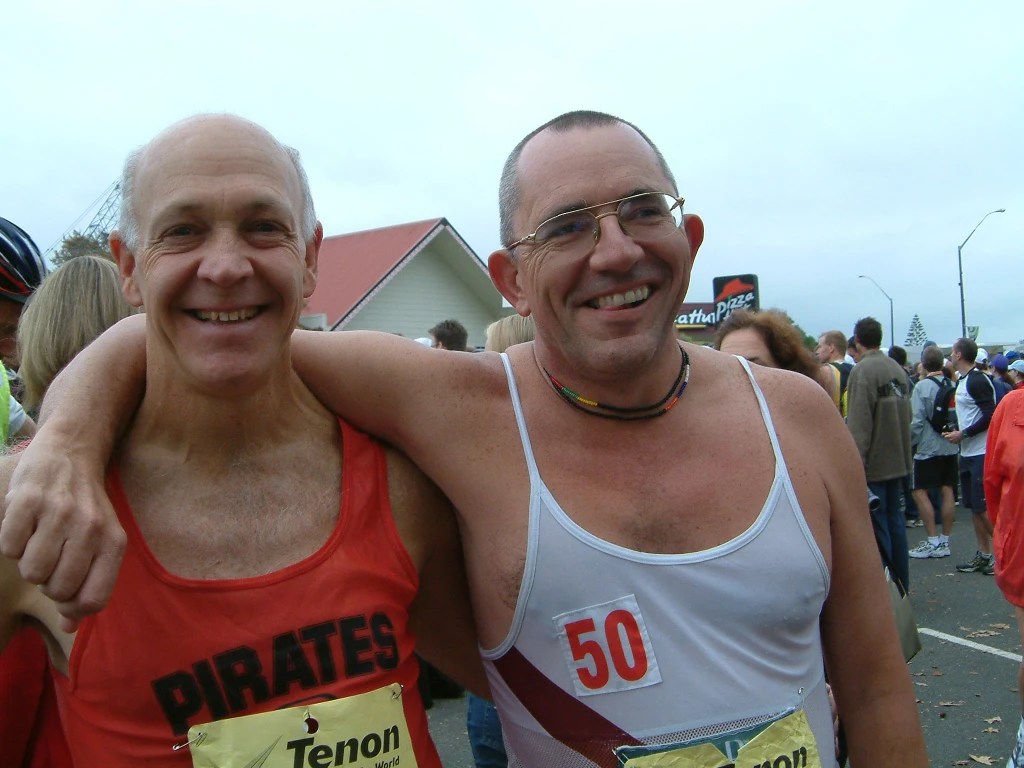
It poured in Rotorua. Fair enough—Africa had rained on me, Europe had drenched me, and New Zealand seemed keen to keep the streak alive. If drought follows the Five-Hour Pilgrim anywhere, invite me over and I’ll rent the Rainman.
My host and close friend, Al, chose to run at my side. He didn’t have to. He’s a proper athlete—not a limping pilgrim counting down kilometres. Al runs like a boisterous puppy: bounding, irrepressible, incapable of sulk. He kept me laughing as the rain needled our faces and the road turned slick.
We tucked in with a gaggle from the YMCA, all in yellow vests—the “Yellow Submarine.” Banter bubbled, jokes traded back and forth, the sort of nonsense that keeps the dark at arm’s length.
At about 30 kilometres, I saw it: that tiny tell in Al’s stride. Friendship stretches, but it also tells the truth. He’d humoured me long enough. He squeezed my hand, flashed a grin, and bounded off. I watched him dance into the bobbing crowd—a quick lesson in love: sometimes a friend runs with you, and sometimes a friend runs ahead so you can finish your own race.
At the 32-kilometre marker, a small damp group shouted, “Kia ora!” A runner near me translated. “Strength to you.” I leaned into the hill and looked down. Done this a thousand times. What could Rotorua throw at me that life hadn’t already tried?
Hours later, Al and Eva were waiting at the soggy finish. The clock glowed in the gloom: 05:12:07. Halfway through the global pilgrimage. Slow, yes. Consistent, also yes. And that matters. I’d earned the right—if not the speed—to call myself the Five-Hour Pilgrim.
“In each race I have learned that the desire to quit comes but once.
It is a coward that once beaten does not return.”
—Tim Noakes
New Zealand was my “once.” Not only quitting the race—quitting the whole mad project. Two marathons in two weeks. More hours on planes than is good for the soul: London, Johannesburg, Dubai, Singapore, Brisbane, Auckland. Fatigue magnifies doubt; doubt magnifies nonsense. In a café after the race, Al delivered his sermon—with gusto and windmill hands.
“If you quit now,” he said, “I’ll kick your sorry ass all the way back to South Africa. You’ve inspired people. They’re daring to dust off old dreams because you chose a ridiculous one and stuck with it. If you stop, you risk confirming a lie—that ordinary people shouldn’t chase extraordinary things.”
I felt exposed, foolish, fragile. Friendship, done right, isn’t a pat on the head. It’s a mirror, a shove, a shelter. I took the shove.
Back home, I took my family for pizza. Franco—old friend, now the neighbourhood Italian—refilled Kay’s glass and added his own verdict.

“Tom, I’ve always thought you a little odd,” he said, “but never a quitter.”
That settled it. I would carry on. Not with bravado, but with honesty: this would be hard, and that was fine. Friendship doesn’t remove the hill at 32 kilometres. It just makes sure you face it with company, courage, and the occasional bad joke about the rugby.
What this taught me about friendship
- Presence over pace. Al ran with me until running ahead served me better. Real friends know when to match your stride and when to clear the road for you.
- Truth is kindness. The pep talk wasn’t gentle. It was loving. Friendship is a safe place for the hard words that keep you moving.
- Community carries. A shout of “Kia ora!” from strangers can push you up a hill. We underestimate how small acts—cheers, coffee, a lift to the airport—become fuel.
- Keep the promise. Slow and consistent beats fast and done. Friends remind you of the promise you made to yourself when you’re too tired to remember.
 Meaning in Motion
You must be logged in to post a comment.