There was worldwide media attention when the contracts were signed. Gary Kasparov couldn’t believe it, the historic match between the World Chess Champion and Deep Blue would be a reality. The tournament was to be staged at the President Hotel in Moscow and already the Deep Blue team was in a panic. They had hardly any time to prepare the machine and they did not yet have all the needed chess chips. The prototypes searched at over a million positions per second, but in truth the theoretical maximum search speed of Deep Blue was closer to 300 million positions per second.
Leonid Nestorov, the team leader knew his computer was going into this match the underdog. With every disappointing day this was becoming clear, but panic was not an option. In spite of the pressure, work went on at a measured pace and Deep Blue was given life. Nestorov was cautious. Based on previous bad experiences he decided to set up two backup machines at the playing site in Moscow. The main super computer, Deep Blue would be housed in a secure room in the nearby New Tretyakov Gallery.
The Deep Blue Team was solemn. No-one wanted to face the uncomfortable reality that they were hopelessly under-prepared. Like a lamb to the slaughter thought Nestorov. He drew on his scanty knowledge of Russian Mythology. “Deep Blue was like a child” he mused. Kashchey the Immortal would surely catch him, devour him.
Nestorov’s team arrived at the President two days before the opening game. The match would be held in the convention centre. Once they booked into the hotel, Nestorov went to the venue to check out the logistics. The entrance hall was cavernous with several high pillars holding up a ceiling two stories above. Standing there and looking up he felt like a small pawn on a board hemmed in by gigantic rooks.
Time passed in a frenetic blur and before anyone could get settled, the big day dawned. The first encounter. The commercial TV channel, Russia Today would broadcast the game internationally and the All-Russia State Television and Radio Broadcasting Company would broadcast internally, throughout Russia. Inside the convention centre Gary Kasparov patiently waited for the Deep Blue team. They decided Nestorov would be the computer controller in the first game. His nervousness palpable.
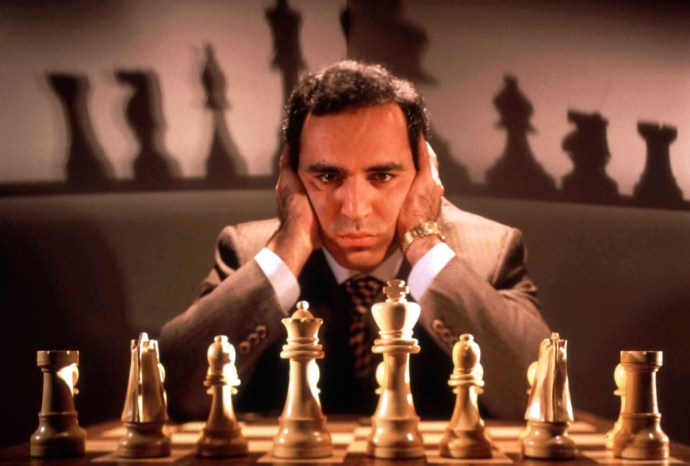
For one split second there was a spark of electricity, a respectful yet combative recognition across the chequered board. Rank on rank the pieces stood, mute. Battle was about to be joined, armies stood at the ready. The computer screen blinked a small green cursor. Kasparov’s eyes were cold and gave away nothing. He had drawn white and was to make the first move. Delicately he reached forward and moved his knight. This was the first salvo.
Kasparov played a shrewd opening first game using direct anti-computer tactics. This involved a style of conservative play for long-term advantage. He was hoping to confuse the computer’s decision making abilities. For the entire game Kasparov’s pieces never left the first half of the board. After the first nine moves Gary and Deep Blue arrived at a familiar position that had been played many times at Grand Master level. The situation was closed and positional and it was hard for the computer to manage.
Suddenly Kasparov diverted from his usual play. He changed from his well-known traditional series of moves. He exposed his anti-computer tactic and deep within the circuitry the machine panicked but realigned. The first was a long, bruising game. In the end Kasparov won. Deep Blue was matched and beaten.
Later Nestorov found a flaw in the strategic architecture which compromised Deep Blue’s positional play. The engineer worked late into the night and into the early hours to fix the problem. Despite the setback the team was in high spirits. One game down, five to go. The Deep Blue team assembled for the post-game media briefing and for a group of people who had just lost the first game they looked surprisingly cheerful to the roughly assembled platoon of reporters.
Mid-morning and the Siberian Express was pulling into Novosibirsk. The sun bright, air crisp. Businessmen in shabby suits, uniformed municipal officials readied themselves for disembarking. Lord-thy-God stared out the window, this wasn’t over yet.
oOo

Nestorov was exhausted, he had hardly slept. He propped himself against the wall as they debated making some changes to Deep Blue’s evaluation function. It was the morning before game two and he needed to sleep. He fixed the bug responsible for the strange moves at the end of game one. Now they were considering a different tactic.
Deep Blue had its turn to start with the white pieces and right from the start he sensed something was going to happen. He gave the controller’s seat to another team member and from the first move Kasparov was playing unpredictably again.
The auditorium was packed and some of the commentators, most of them chess masters themselves, were saying how weak Deep Blue’s opening preparation was. Deep Blue had allowed Kasparov to easily achieve a closed position. They did not say it outright but the consensus amongst the commentators was that Deep Blue would lose the second game.
On the Siberian Express Lord-thy-God smiled inwardly.
The Deep Blue team watched intently, Nestorov’s weariness had worn off and he was suddenly alert. Move after move the commentators continued to say that the computer was in trouble. Up in the game room things were different. Slowly but surely the team watched as Deep Blue’s assessment of its positional edge start to creep up. Nestorov’s programme changes seemed to be working, he knew this game was going to be different. On the giant TV screen it was a small almost unnoticeable move but Kasparov shook his head.
“I have got you.” whispered Nestorov under his breath.
The operator facing the World Champion signalled for a change and Nestorov pointed to Zaitsev “Go get ‘em, Tiger.” He walked up to the table and sat down. He had never been so close to Kasparov in a game before and he was nervous. He didn’t want to break the Champion’s concentration so he just nodded a polite greeting and sat down. He got a shock when he looked at Kasparov’s face. He looked like someone who had just woken up from a bad dream. Part of his face was visibly red as if he had slept on that side for a while. The tide was turning. Then suddenly Deep Blue seemed to go into panic mode. The computer slowed down and was taking almost 15 minutes to make its move.
The game seemed to be leading for a draw, although to the controller it seemed that Deep Blue had a slight advantage. Then, suddenly after Gary’s forty-fifth move, he stuck out his hand and shook Zaitsev’s – “I resign.” What a firm hand-shake you have he thought.
Quickly it was all over and Kasparov left the building with his entourage. Nestorov was dazed, he couldn’t believe it. Deep Blue had won. The scores even. “Can there be a god?” he wondered. At the back of his mind in a place he could not fathom, for it was too deep and too far away. “Working on it.” came a distant reply.
It was Satan’s turn to smile.
oOo
The Deep Blue team was elated, Kasparov could be beaten. The smile on Nestorov’s face was radiant. He had poured mind and body and soul into this moment. How many weekends, nights and early mornings had he sacrificed? Said one of the commentators after the game “This is a game that any human grandmaster would be proud to play for white. This was not a computer-type game. This was real chess.”
The tournament was drawn at one game each with four more games to go.
Tension was beginning to mount and even before the third game began there were claims and accusations levelled at the Deep Blue team. Kasparov intimated that there may have been underhanded tactics and even cheating involved. It was scandalous of course, and the Deep Blue team ignored the calls. Their focus was on making chess history. The team was convinced Kasparov would stick with his spoiling anti-computer chess tactics. The opening move made by the grandmaster, now playing white in the third game, suggested it. It made no matter. The Deep Blue team were prepared for it. The game was unremarkable and without much drama. In the end Deep Blue just shuffled its king backwards and forwards and Kasparov was forced into conceding the draw.
“There is a human intelligence I can see behind Deep Blue’s moves.” Kasparov grumbled afterwards. I am no longer playing a machine. Pyotr Veniaminovich Svidler, a chess commentator asked, “If I am reading you correctly, do you think there may have been some kind of human intervention during the game?” Gary Kasparov was clearly angry. He glared and stormed off. The tension between the Deep Blue team and Kasparov at the start of the fourth game was intense. In the end an offer to draw was made. After four games the tournament was tied with two points each.
The train was dead on time
In the fifth game, Kasparov reverted to the similar spoiling strategy taken in game one. At some point the match looked all but over for Deep Blue. Kasparov looked like he would secure the win. Suddenly from nowhere the tables were turned. With brilliant and unconventional end-game play, the computer forced a draw. Nestorov was elated. The Siberian Express rattled into the setting sun, Satan inwardly smiled.
After five games the match was tied at 2.5 points each. Deep Blue had the advantage of white in the last game. Unless Kasparov could manage a win using black, history was about to be made. Deep Blue would be the first computer to tie the World Chess champion in a regulation match.
Nestorov and his team were hoping for something even better, they wanted to beat the World Chess Champion.
The excitement spread. The scalpers were out in full force, tickets were sold at more than ten times their face value. The media were in a feeding frenzy. Kasparov kept his distance but the Deep Blue team were mobbed. What was going to happen? It would all came down to one last game.
Evening was darkening into night as the Siberian Express pulled out of Omsk. With the World’s eyes on the final game, somewhere in the warp and weave of time and space, two adversaries faced each other. Ahead lay Kirov and then Moscow’s old railway station, Yaroslavsky. The train was dead on time.
 Meaning in Motion
You must be logged in to post a comment.